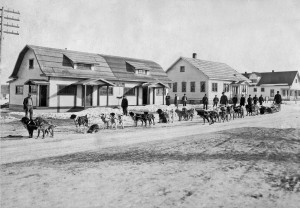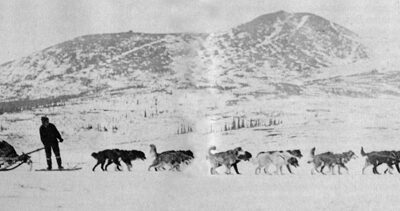
The Iditarod Trail—as an actual continuous trail—had origins in that richest, most glorious period of Alaska history, the Gold Rush Era. It was a time of daring men and daring events that forced the lock and broke the silence of the unknown North. Gold rush led to gold rush, trail led to trail, until it culminated in the Iditarod, the last, fabulous, hell-bent-for-leather gold stampede and final great gold rush trail in North America.
For a glorious moment, the Iditarod Mining District teemed with over 10,000 stampeders. Timed, as it was, several years after the most available placer gold of the Klondike, Nome, and Fairbanks had been mined, and after the hordes who had rushed to those blockbuster strikes had folded their tents and left, Iditarod and its surrounding settlements briefly glittered as Alaska’s largest population center.
As with the other great strikes, once Arctic winds blew and the sun fled south, for seven to eight months a year the waterways which provided the gold communities such cheap, easy travel, communication, and supply during summer were locked down, frozen tight. Then the citizenry turned to winter trails, narrow, long threads connecting them to the industrialized world, and everything that came in or moved out went by foot or dog team.
As had every one of the other major rushes, Iditarod grew its own trail system. Legendary drivers and legendary dogs traveled its miles and the Iditarod Trail itself became a trail of legend, this final, great gold rush trail.
But as did all of the major gold rush trails of a century ago, the old Iditarod Trail became a relic. As it fell into disuse, the undisturbed, cleared swath provided a perfect environment for seeds to sprout and trees and brush to spring up. Only a few stretches near villages and remote hunting lodges continued to be kept open by use. Year by year, more of the marker tripods rotted, fell, and returned to the soil. The roadhouses succumbed as well. Those with sod roofs went first. Then, one by one, even those with more lasting roof construction had their covering cave in, leaving walls, floors, and the rest of the once-snug havens to be obliterated by nature.
And so, just as the great dogs and grizzled travelers who had frequented its miles waned and disappeared over the final, Great Divide, the Iditarod, the last great gold rush trail in North America, faded into silent memory.
But the old trace did not die; it only slept.
That no road was ever built over the old trail’s route and that the country it traverses remains largely raw wilderness preserved its primitive character and colorful gold rush luster through the decades of abandonment as if the trail has an appointment with destiny.
To the trail’s romantic allure may be attributed one of the main reasons the Iditarod would one day live again. A half century after heavy trail use died out, in a “man-and-team-against-the-wilderness” setting, the old path experiences a glorious rebirth. From its long slumber it awakes to hear the barely audible hiss of runners and the creaking of sled joints, it feels the staccato footfall and listens to the panting of trotting huskies. The most wondrous sled dog race of all time, a fabulous contest of unprecedented proportions, is held over its spectacular course.
Nothing else will so universally be acclaimed to epitomize the Spirit of Alaska. In future years, Ian Woolridge of the London Daily Mail will coin the phrase to describe the event, “The Last Great Race on Earth.”
|
|
This is a wonderful account of the rebirth of the Iditarod Trail, but the sentence, “From its long slumber it awakes to hear the barely audible hiss of runners and the creaking of sled joints, it feels the staccato footfals and listens to the panting of trotting huskies.” brought tears to my eyes. This, to me is Iditarod.