Fat Albert Shows His Stuff

The first two Iditarod Races were the only two to ever go the whole distance from Anchorage to Nome completely by dog power. All other Iditarods have included a lift by truck from a pickup area either at Eagle River or near Anchorage for a restart at one of several trailheads up in the Mat-Su Valley, in the early years at Knik Lake, later in Wasilla, and now at Willow, where snow is pretty much guaranteed.

The following is part of my account of the first day of the first Iditarod Trail Sled Dog Race ever, the trailblazing run. The full account is related in my book, TRAILBREAKERS Pioneering Alaska’s Iditarod, Volume II, The Most Daring Iditarod Adventure of All Time, Founding The Last Great Race on Earth. I set down the route of that first race in some detail so that when we pioneers are gone, there will be a record for race history buffs and documentarians.

The Alaska Sled Dog and Racing Association put in the Iditarod Trail out of Anchorage as far as Fort Richardson lands. There, the army provided a route that crossed the Glenn Highway near the highway weigh station and passed across Eagle River. Where the way left military land west of the town of Eagle River, the soldiers handed off trail routing to  the Chugiak Dog Mushers. The club had broken out old trails through the woods between the town of Eagle River and the Alaska Railroad.

Their route ran by the old railroad powder magazine that would later be “removed” by young vandals in a terrific nighttime  blast that, had it occurred under heavy cloud cover to contain the force, would have probably heavily damaged much of Eagle River.

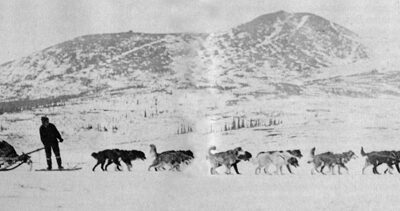
Into the woods uphill from the magazine, the Iditarod Trail continued on a long abandoned woods road traversing what is now crisscrossed by the Chugiak High School cross-country ski trail system. Right there, I heard the call, “Trail!” from behind. I pulled over to let Raymie Redington go by driving Rough and Ready and the rest of his dad’s nine-dog team. At the last minute, with no preparation or time to get ready, Joe had drafted Raymie to enter. They passed and off we went in the usual spirited chase.

The woods road connected with the old Birchwood Camp Road, and shortly crossed the railroad tracks in a tight U-turn. As we greatly accelerated downhill over the fast, icy road, chasing Raymie, around the corner and over the tracks we flew. The sled slewed wide with the centrifugal, then, catching a runner edge, flipped.

As the sled went over, in a kind of daze, probably from the severe sleep deprivation of the prior week, (a total of fourteen hours sleep in the preceding ten days, almost none in the final five and absolutely none in the last three as I fought to get ready to go) I simply let go—the dog driver’s unpardonable, “thou shalt not” sin!”

Tumbling on the ground, and with my team disappearing in pursuit of Raymie, I instantly regained concentration and cried out in panic, “Whoa Albert!”

I had seen my trusty leader perform some impressive responses to my commands, but none more amazing or valued than bringing that pursuit-crazed team to a screeching halt on that rock-hard icy road and holding it there until I ran and regained the sled.

I often explain to non-mushers that these high-octane sled dogs we drive have one whale of a lot of GO in them, but hardly a trace of WHOA. Truly, only a fellow dog driver could fully appreciate all of the aspects of Fat Albert’s accomplishment!


Learn about Rod’s two-volume work,
TRAILBREAKERS, Pioneering Alaska’s Iditarod at
www.rodperry.com


One thought on “Fat Albert Shows His Stuff

  1. Wonderful story; terrific history lesson. Loved the first line of your last paragraph, but have to disagree. Yes, the dogs respond frenetically to GO, but they react just as enthusiastically to WHOA — with a resounding NO! (HAHAHA)

Leave a Reply