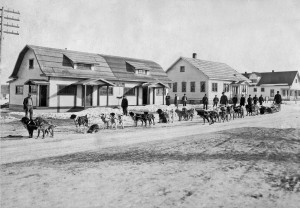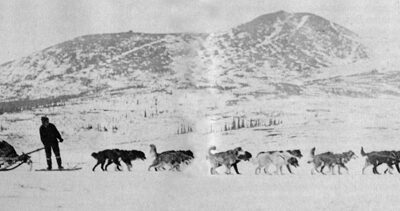
Think you know all about how the Iditarod Trail Sled Dog Race was born and drew its first breath? Not many, even back in the day, were privy to the behind-the-scenes, inside story. And today, I daresay that not one in ten thousand of even the most avid Iditarod Race fans has much of a knowledge. Even among racers and the media, but a scant handful are well versed in our race’s beginnings. This continuing series lifts a few bits and pieces of the amazing founding story from my book TRAILBREAKERS Pioneering Alaska’s Iditarod Volume II.
Readers who only pick up here without reading part 1 of the series will be short-changing themselves. As Joee and Raymie Redington, sons of the late Joe Redington Sr., “Father of the Iditarod” vouched on a TRAILBREAKERS cover-quote, “Rod’s got his facts down. Dad would be proud of this book.”
Through the several years of Joe Redington and his Iditarod Trail Committee’s planning, though their original Knik-to-Iditarod-and-back plan had always excited a limited group of red-blooded adventurers, there just seemed to be something ho-hum about the model to the non-dog-driving public. Joe wondered, did it need something to shore it up, changed to make it different, what? From the first he had looked to create a phenomenon so magnetic, so compellingly irresistible that the world at large would not be able to escape its pull.
Joe was extremely stubborn when it came to ignoring race detractors. At the same time, he tried to be analytical, keep an open-minded attitude and listen. Might it be that some of his detractors provided a clue to increasing the appeal of the event? Referring to his Knik-Iditarod-Knik model, people kept repeating—some in a manner of honest inquiry, others in a tone of scoffing sarcasm—“From where, to where and back?”
No one cared about Joe’s home area of Knik. What had once been an important Iditarod Trail supply and jumping-off point had dwindled by the early 1970s to a few dozen homes scattered through the woods at the end of an out-of-the-way road. And with virtually nothing left of the old gold rush town of Iditarod, it seemed that nobody knew where the ghost town with the funny-sounding name was or cared one whit about it.
With the exception of the handful of residents of the remote villages of McGrath and tiny Takotna and the handful of hunting lodge winter caretakers and a few trappers, the event would be invisible. It looked like a private race for Iditarod insiders.
There seemed to be a problem, too, in the modest psychological appeal of a race that appeared redundant: the event would go out one way, then turn around and just repeat itself, coming back over the same old path. To say it would be monotonous would be a stretch, but it would certainly not be as interesting as a contest that keeps progressing start to finish over exciting new ground.
Maybe racing to Iditarod and back wasn’t quite enough.
In the summer of 1972 someone had asked Joe, “why don’t you go from somewhere to somewhere?”
When in the fall of 1972 Tom Johnson and Gleo Huyck had locked arms with Joe, telling them they were in it heart and sour to help him get his race off the ground that coming March, one of the first items on their agenda was to gain manpower. At the suggestion of Cathy Johnson, they approached the Ad Hoc Organizing Committee of Young Democrats to help. Ad Hoc was made up of youthful, ultra liberals who had recently all but taken over local precincts of the Alaska Democratic Party. The Old Guard Democratic establishment detested them. Counter-culture personified, it goes without saying that they shocked Republican conservatives. But if they could bail out the Founding Three with desperately-needed manpower, Joe could not care less who or what they were. Their leader invited Joe to come visit them at “The Warehouse.”
The Warehouse was a large garage and attached living area in Anchorage. In that day of “find-yourself,” “do-your-own-thing,” “love-in” hippies and communal living the place was a veritable rabbit warren, housing a large number. As Joe dropped by to get acquainted, a sign on the door read, “Don’t knock, just walk in.” Joe shrugged and opened the door. A woman clad in nothing more than her birthday suit greeted him. Recoiling, Joe stammered, sorry, he must have mistaken the address. She said no, they were expecting him, please come in.
To be continued
|
|