Nome—The Golden Key (part IV)

Not one in ten thousand of even the most avid race fans has a clear and complete understanding about beginnings of the Iditarod Trail Sled Dog Race. For instance, how did it come to be that the race ends in Nome? If you think it was because Race creators wanted to commemorate or recreate the Serum Run, you’re certainly needful—if you’re fan enough to care—of a tutorial to straighten out your notions.

If you’ve just joined in, notice that this is part four. I’d highly recommend you drop back to the beginning and read the three prior Nome—The Golden Key posts.

Part four picks up where the race organizers have revamped the Iditarod Race to go Anchorage to Nome instead of Knik to Iditarod and back and all of the Iditarod Trail Committee, but particularly race founders Redington, Johnson, and Huyck, are beginning to see that they have stumbled upon a bonanza of advantages.

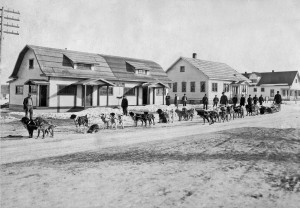
Bringing Nome into the plan would take advantage of the town’s established name recognition. It was world renowned as Alaska’s most lustrous gold rush city. Time after time during its glorious past Nome had captured world attention. Newspapers around the earth had carried turn-of-the-century stories of the rush for riches and the fabulous finds that overnight made paupers rich as Midas. During its rip-roaring heyday, colorful characters abounded in Nome such as Old West lawman and gunfighter, the legendary Wyatt Earp, who had operated a saloon there, and Tex Rickard, the most famous fight promoter of all time, builder of the third incarnation of Madison Square Garden, and founder of the New York Rangers.

Then, two decades after the great gold rush, long after the once-brawling town had settled into its reduced, quieter form and largely dropped out of the news, a deadly diphtheria epidemic had threatened to wipe out Nome. Could a desperate dog team relay get serum there in time to save the stricken population? Newspapers and radio had kept untold millions breathless. Once more Nome had held the eyes and ears of the world captive.

If Joe and his men wanted to bring village Alaska into the excitement and do something about stopping the extinction of village teams (this was one of the three stated goals the committee worked under) taking the race through the numerous villages located along the Anchorage-to-Nome route was a vast and dynamic upgrade. Whereas the initial Knik-Iditarod-Knik plan would have gone through but McGrath and tiny Takotna, Joe, Tom, and Gleo layed out a route to Nome that would take in those two villages plus eleven other important Native towns.

Instead of inhabitants of those villages being limited to hearing sketchy reports from the trail, bringing the race through their very town would let them see and feel and participate. They would then take pride and gain a sense of ownership of the event. Additionally, bringing all those villages into the fold would naturally add thousands of man hours of volunteer labor to the checkpoint-operation and trail-breaking efforts.

The new model carried with it even more wonderfully serendipitous advantages:

  1. Though the one-way distance of the new trail exceeded the old, approximately 1,100 miles to Nome opposed to 400 to Iditarod, the new route would require, essentially, no more virgin trail breaking. After the racers reached the Yukon the rest of the way would be over village-to-village trails.
  2. Instead of redundantly going out and back, the course would  now take on a much more captivating character by going one way, continually proceeding over interesting new country.
  3. Lengthening the race to Nome would extend the trail to include a section of the famous Yukon River, adding that romantic, world-renowned place name. It would, as well, push the distance beyond 1,000 miles. The name and distance with such attractive rings handed organizers additional promotional magic.
  4. Proceeding from the interior—“Indian Country”—on to the Bering Sea would hand the Iditarod several other gems. Expanses of sea ice and tundra would add highly interesting physical variety to the course, and the ever-present threat of coastal blizzards would be sure to provide wonderful race-story drama. Best of all, it would finish the race by taking it more than 200 miles through the land of the Eskimo, the colorful people group many commonly identify most closely with Alaska.
  5. Difficulties connected with media coverage along the Knik-Iditarod-Knik route had always provided naysayers logical ammunition. It was almost totally uninhabited. How many city reporters and their pilots would venture out knowing they’d have to stamp a camp out of snow up to their keesters beside the bush plane each night at who knows how far below zero? While it still seemed unlikely the media would follow an Anchorage-Nome event, at least if they did, once the race reached the villages reporters could bed down on the floor of the Village Community Building, the church, or on someone’s couch and gain help of the town’s communication system to get reports back to headquarters.
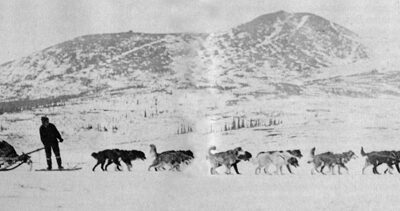
  6. Probably the greatest addition of all, at least from a promotional standpoint, one that would eventually be found to be of bedazzling advertising and marketing worth to the race, was that once the Iditarod Trail of the gold rush era (as distinguished from the Iditarod Race Trail) finishes at the point it meets the Yukon, in order for racers to reach Nome they needed to travel another 400-plus miles, continuing a course over three other trails (old thoroughfares that long predated the Iditarod gold discovery), namely: part of the Yukon River Trail that winds along the great river for over two thousand miles, the Kaltag Portage between the Yukon River and the sea, then the Coastal Trail up the seacoast to Nome. Herein lay the bonanza: That 400-plus miles beyond the old Iditarod Trail takes the race smack over much of the hallowed route followed by the legendary Serum Run!

To be continued


Learn about Rod’s two-volume work,
TRAILBREAKERS, Pioneering Alaska’s Iditarod at
www.rodperry.com


Leave a Reply