Snow to Our Kiesters; Will Winter Ever End?

Life’s sure tough here along the old Iditarod Historic Trail. Al Gore’s world might be warming somewhere, but certainly not in these parts. Here it is April 7th, the day before Easter, and word just came that as of a couple of hours ago we had broken the all-time Anchorage area record for winter snowfall. 

The other day I stopped my car to say hi to a friend pushing her triplets in a three-seat stroller. As I opened the pick-up door to step out she pointed to alert me to something behind me. My eyes naturally looked for something on my level. It was not until she redirected my gaze upward that I was startled to see a moose towering above, stripping bark high up the trunk of a willow tree while standing atop an eight-foot high snowdrift above the street. Not often you can look up at the belly of a moose without being in some kinda deep yogurt!

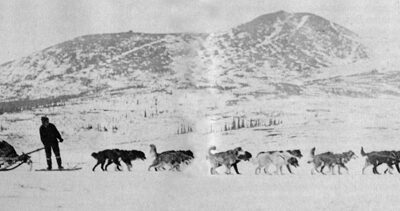
This would be a fabulous time for training lead dogs like I used to up near Montana Creek. Deep snow covers almost all of the brush and downed timber, making the country like a park under the trees. After warm daytime temperatures have turned the top of the pack mushy, freezing nighttime temps set it up hard. With that perfect running surface you can gee and haw your dogs anywhere you chose to go. You just have to make sure you’re outta there by mid-morning, before the integrity of the top layer succumbs to the sun. If not, you’d better have packed a camp—including lunch, dinner, breakfast and dog food—in your sled basket.

You wanna train good lead dogs, you gotta get ‘em away from trails! Most novices think they have a leader when the dog thinks gee and haw are directions given to tell him which TRAIL to take. You give that kind of leader a command with no branch trail in sight to turn onto, and he’ll keep on going watching for one. That’s no leader. A real lead dog’s been trained that gee and haw direct him what DIRECTION to take. If I’m on a trail and command, “Gee,” branch or no branch I want Fido cracking a right turn over into deep snow so instantly it almost gives me a whiplash.

On the first day of the 1977 Iditarod I broke my break not far from the start. Not able to slow my fresh team as well as I would have liked, I passed 27 teams on my way to the first checkpoint, Susitna Station. Some of it took some pretty tricky lead dog work. A number of the racers commented later about the skill of the leaders. I told them I trained my leaders by driving the team away from any semblance of a trail an hour a day except for seasons when the mileage grew too demanding. That’s the way you develop leaders you can steer like a car, following the slightest nuances of your whims and turning by great or tiny degrees. Especially in those early Iditarods when the way was often unmarked, such control was golden.

How did I get off on training lead dogs when I began with commentary on snow depth and endless winter?

Anchorage breaks 57-year-old record for snow in one season

 Dan Joling / AP

Mallards take off from ice as a juvenile trumpeter swan swims by on Friday, April 6, 2012, at Westchester Lagoon in Anchorage, Alaska. The waterfowl made an appearance as nearly an inch of snow was falling on Alaska’s largest city.

By msnbc.com staff

Anchorage on Saturday surpassed a 57-year-old record for snowfall in one season, the National Weather Service reported.

The old record of 132.6 inches in Alaska’s largest city occurred in 1954-1955, it said. But 3.4 inches of snow that fell from midnight to 4 p.m. local time pushed the season total to 133.6 inches — more than 11 feet, the National Weather Service said.

The total is nearly double Anchorage’s normal amount, The Associated Press said.

The city was 2.5 inches short of the record going into Easter weekend, NBC station KTUU said.

Advertise | AdChoices

Snow began falling Friday morning, with 0.8 inches accumulating. More fell overnight Friday and throughout the day Saturday.

The season got off to a slow start, KTUU said.

The first snow didn’t arrive until the Oct. 30. But each month from November to February there was above-normal snowfall, KTUU said. November saw the greatest snowfall, with 32.4 inches, close to three times the average for the month.

By March, Anchorage was on pace to shatter the record, but a slightly below normal month seemed to dim the chances of breaking the 1954-55 record, KTUU said.

No snow fell from mid-March until Friday, The Associated Press reported. Going into April, 3.3 inches were still needed to break the record.

Records have been kept at or very near the current location near the Ted Stevens International Airport since 1953.

City snow removal crews have hauled more than 2.5 million cubic yards of snow to the city’s six snow disposal sites, which are close to capacity, The Associated Press reported. Maintenance and operations director Alan Czajkowski said that volume would almost fill the Louisiana Superdome in New Orleans.

At the height of the snow overload, many residential streets were rimmed by snow-walled canyons that towered over fences and shielded homes. Some roofs collapsed, mostly on older commercial buildings with flat roofs.

On Friday afternoon, falling ice outside Anchorage crushed a car, trapping a 32-year-old woman inside and shutting the Seward Highway. Rescuers and passersby freed the woman and got her to a hospital, where she is recovering with severe head and neck injuries.

This article includes reporting by The Associated Press.

Leave a Reply